Screen time reports are strangely unsatisfying. Six hours can mean a day of focused work, or a day of two-minute fragments that leaves you unable to read a page in the evening. The number is the same; the day is not.
What the research increasingly points to is not duration but fragmentation.
Switching has a cost you do not feel
Every switch between tasks leaves a residue: part of your attention stays with the previous thing. Do that a few hundred times a day — a notification here, a tab there — and you accumulate a kind of fatigue that feels like laziness but behaves like depletion.
This is why the evening can feel empty despite nothing objectively hard happening. The day was not heavy; it was fractured.
Four changes that do more than a screen-time limit
- Turn off non-human notifications. Keep messages from people; silence everything generated by an algorithm. This single change removes most involuntary switches.
- Work in blocks with a visible end. Twenty-five or fifty minutes, then a real pause. The point is not productivity — it is giving attention somewhere to rest.
- Separate consumption from communication. Checking messages and browsing feeds are different activities; doing them together turns a two-minute task into twenty.
- Put a wall between the phone and the bed. Charge it in another room. Nothing else you do for sleep is as reliably effective, and nobody regrets it after a week.
Measure switches, not hours
For two days, note roughly how often you pick up your phone rather than how long you use it. The number is usually more surprising — and more actionable — than the weekly screen-time report.
The evening question
Late-night scrolling is rarely about the content. It is usually the only unclaimed time in the day, which is why "just go to bed" advice fails so consistently — you are not choosing the phone over sleep, you are choosing time-for-yourself over sleep.
The workable version is to replace it rather than ban it: something absorbing that ends naturally. A chapter, a stretch, a walk, a conversation. The requirement is not that it is virtuous; it is that it stops on its own, which feeds are designed never to do.

Kiva's take
You do not need a digital detox. You need one hour a day where nothing can interrupt you — and a charger that lives outside the bedroom.
When it is more than a habit
If screen use is displacing sleep most nights, if you feel anxious when separated from your phone, or if low mood keeps you scrolling for hours you cannot account for, that is worth raising with a doctor. Persistent low mood and anxiety respond to treatment — and both make attention worse, which makes the cycle harder to break alone.
Frequently asked questions
Does screen time before bed really affect sleep?
The content and timing usually matter more than the light. Engaging, emotionally activating material close to bedtime delays sleep onset, and the hours displaced by scrolling are the clearest cost.
How much screen time is too much?
There is no meaningful universal threshold for adults. A more useful question is whether screens are displacing sleep, movement or face-to-face contact — those displacements are what research links to poorer wellbeing.
Do blue light glasses help?
Evidence for blue-blocking glasses improving sleep is weak and inconsistent. Consistent sleep and wake times, and not taking your phone to bed, have far stronger support.
Keep reading
How much sleep do you actually need?
The honest answer to the 8-hour question, why sleep debt compounds, and what to fix first.
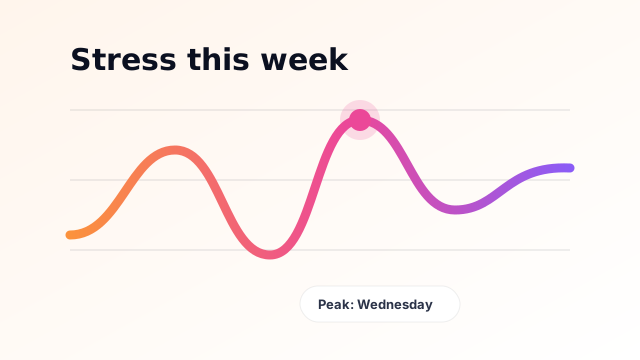
Stress and cortisol: what actually helps
Cortisol is not a villain. What stress does in the body, when it turns costly, and the interventions with real evidence.