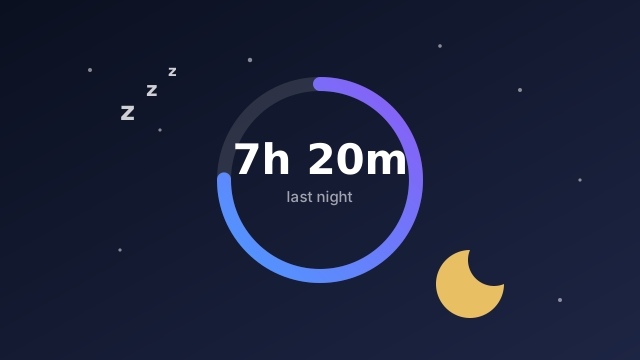
Sleep guidance for adults generally lands on seven to nine hours a night. That range is genuinely useful, and it is also where most advice stops — which leaves you with no way to know whether your seven hours is fine or whether you have been quietly under-slept for years.
Finding your own number
Three signals tell you more than any tracker:
- You wake shortly before your alarm on most days rather than being torn out of sleep by it.
- You are alert in the early afternoon without caffeine. A mild post-lunch dip is normal; fighting to stay awake is not.
- You do not sleep dramatically longer on free days. If you sleep nine and a half hours every Saturday, your weekdays are too short.
A simple test: take a week with no early obligations, go to bed when you are genuinely sleepy, and let yourself wake naturally. By day four or five, the average of your nights is close to your real need.
How sleep debt actually behaves
Sleep debt accumulates like a credit card: losing an hour a night for a week does not simply mean you are one hour behind on Sunday. Research on partial sleep restriction shows performance keeps degrading across consecutive short nights — and, uncomfortably, people's self-rated sleepiness stops tracking their actual decline. You feel adapted while your reaction time says otherwise.
Recovery is real but partial. One or two longer nights restore a good share of alertness; they do not undo everything, and a large weekend lie-in shifts your body clock later, which makes Monday morning worse. A smaller, steadier correction — 30 to 45 minutes earlier to bed on weeknights — beats a heroic weekend.
The 20-minute rule
Moving your bedtime earlier by 20 minutes is invisible to your evening but adds more than two hours of sleep a week. Nobody keeps a 90-minute change; almost everyone keeps 20 minutes.
The five changes that fix most sleep problems
1. Fix the wake time first, not the bedtime
Your body clock anchors to when light hits your eyes in the morning. A consistent wake time — including weekends, within about an hour — does more to stabilise sleep than any bedtime rule.
2. Get outside within an hour of waking
Even an overcast morning outdoors is many times brighter than indoor lighting. Ten to twenty minutes of daylight early sharpens the signal that sets your rhythm for that night.
3. Move the caffeine deadline
Caffeine has a half-life of roughly five hours, so a 4 p.m. coffee still has a meaningful dose circulating at 9 p.m. Most people who "sleep fine after coffee" are sleeping more lightly, not sleeping normally. Try an eight-hour gap before bed for two weeks.
4. Separate the bed from the struggle
If you are awake and frustrated for more than about 20 minutes, get up, keep the lights low, do something dull, and return when sleepy. Lying in bed trying harder teaches your brain that the bed is where you are alert.
5. Give your body a reason to wind down
A dark, cool room and a predictable 30-minute pre-sleep routine outperform any supplement. The point is not the specific ritual — it is that it repeats, so it becomes a signal.
What sleep trackers are good and bad at
Wrist-worn trackers estimate total sleep time and bedtime consistency reasonably well — and those two numbers are where nearly all the practical value sits. They are considerably less reliable at dividing the night into light, deep and REM stages, because they infer stages from movement and heart rate rather than brain activity.
So use the trend, not the verdict. "My average is 6h 40m and my bedtime moves by two hours" is actionable. "I only got 42 minutes of deep sleep" mostly generates anxiety — and anxiety about sleep scores is common enough to have a nickname, orthosomnia.

Kiva's take
If a sleep score makes you dread going to bed, hide it for two weeks and track only bedtime and wake time. Those two lines fix more nights than any stage chart.
When it is not a habit problem
Some sleep problems do not respond to routine changes because they are not about routine. Loud snoring with pauses in breathing, waking unrefreshed despite adequate hours, persistent early-morning waking with low mood, restless legs, or insomnia lasting more than three months all deserve a medical assessment rather than another app tweak.
Cognitive behavioural therapy for insomnia (CBT-I) is the recommended first-line treatment for chronic insomnia in adults and outperforms sleeping tablets over the long term. It is worth asking about by name.
Frequently asked questions
Is seven hours enough sleep?
Seven hours is within the range recommended for most adults, but the right amount is individual. If you wake without an alarm feeling rested and stay alert through the afternoon without caffeine, you are probably getting enough.
Can you catch up on sleep at the weekend?
Partly. One or two longer nights restore some alertness, but they do not fully undo a week of restriction, and sleeping several hours later at weekends shifts your body clock and makes Monday harder.
Are sleep tracking numbers accurate?
Consumer trackers estimate total sleep time reasonably well but are much less reliable at splitting it into stages. Use the trend across weeks rather than treating a single night's stage breakdown as fact.
Keep reading
How to track calories accurately (without hating it)
Why most food logs drift 20–30% off, and the five habits that make tracking accurate enough to be useful.
The four phases of your cycle, explained simply
What actually changes across follicular, ovulation, luteal and menstruation — and how to plan food, training and rest around it.