Most people are taught two facts about the menstrual cycle: it lasts about 28 days, and one week of it involves bleeding. That leaves three weeks unexplained — which is unhelpful, because those three weeks are where most of the energy shifts, appetite changes and mood swings actually live.
Here is the whole sequence in plain language, plus what the evidence does and does not support about training and eating around it.
The map: one cycle, four phases
A cycle is counted from the first day of real bleeding (day 1) to the day before the next period starts. Typical length is 21–35 days in adults, and it is normal for your own length to vary by a few days month to month.
| Phase | Roughly when | What is happening |
|---|---|---|
| Menstruation | Days 1–5 | The uterine lining sheds; oestrogen and progesterone are at their lowest |
| Follicular | Days 1–13 | Follicles mature, oestrogen climbs steadily |
| Ovulation | Around day 14 | An egg is released after a surge in luteinising hormone |
| Luteal | Days 15–28 | Progesterone rises, then falls if pregnancy does not occur |
Note the overlap: menstruation happens inside the early follicular phase. The four names describe events, not four separate weeks.
Phase 1 — Menstruation (days 1–5)
Hormones are at their floor. Many people feel flat on day 1–2, then noticeably better by day 3 as oestrogen begins to rise. Cramping, lower back ache and disturbed sleep are common in the first 48 hours.
What tends to help: keeping movement gentle but present (walking, easy cycling, mobility work often reduces cramping rather than worsening it), iron-containing foods alongside vitamin C if your bleeding is heavy, and warmth for cramps. This is a poor week for judging yourself on training performance.
Worth a doctor's visit
Bleeding that soaks through protection hourly, lasts longer than seven days, or pain that stops you from working or sleeping is not something to simply track. Heavy or severely painful periods have treatable causes — see a healthcare professional.
Phase 2 — Follicular (days 1–13)
As oestrogen climbs, most people report the best stretch of the month: energy returns, mood lifts, appetite is stable and recovery from hard training feels easier. If you are going to attempt a personal best or start something demanding, this is the window most people find easiest.
What tends to help: putting your harder sessions and your most demanding work here, and using the stable appetite to build habits rather than to restrict.
Phase 3 — Ovulation (around day 14)
Oestrogen peaks and an egg is released. Some people notice one-sided twinges, a rise in libido, clearer skin, or a change in cervical mucus to a clear, stretchy texture. Basal body temperature rises slightly after ovulation, which is why temperature alone confirms ovulation only in hindsight.
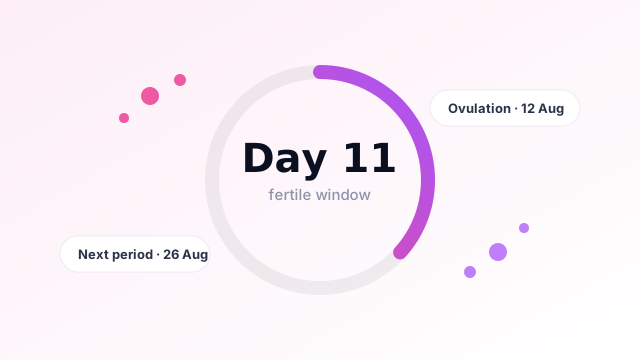
The fertile window spans roughly the five days before ovulation plus the day of ovulation, because sperm can survive several days. This is the part apps estimate — and the part they get wrong most often, since ovulation day moves.

Kiva's honesty note
Predictions in any cycle app — including ours — are estimates built from your past cycles. They are useful for planning and awareness. They are not contraception, and they cannot confirm pregnancy.
Phase 4 — Luteal (days 15–28)
Progesterone rises, body temperature sits slightly higher, and for many people this is where things get harder: appetite increases, sleep becomes lighter, and mood becomes more reactive in the final days as both hormones drop. Premenstrual symptoms belong here.
What tends to help: planning for the appetite increase instead of fighting it (more protein and fibre, regular meals rather than heroic restriction), protecting sleep, and lowering the ambition of your training slightly in the last few days rather than skipping it entirely.
If low mood, irritability or anxiety in the luteal phase is severe enough to disrupt your relationships or work, that pattern has a name — premenstrual dysphoric disorder — and effective treatments exist. It is worth raising with a doctor rather than enduring.
Should you really train and eat by phase?
Phase-based programmes are marketed with more confidence than the research currently supports. Studies on strength and endurance across the cycle show small and inconsistent average effects, with large differences between individuals. In other words: the average tells you little about you.
The approach that holds up is simpler. Track energy, sleep quality, symptoms and how sessions felt for two or three full cycles. Look for your own repeating pattern. Then adjust — perhaps you consistently feel strongest in the follicular phase and need one lighter week before your period, or perhaps your pattern barely moves. Both are normal.
What is worth logging
- First day of real bleeding — everything else is calculated from this.
- Flow and duration — the fastest way to spot a change worth investigating.
- Symptoms — cramps, headaches, breast tenderness, bloating, skin, digestion.
- Mood and energy — one tap a day beats a detailed diary you abandon.
- Sleep — luteal-phase sleep disruption explains a lot of "random" bad days.
Three tracked cycles is usually enough to see a pattern. Six gives you predictions worth planning around.
Frequently asked questions
How long is a normal menstrual cycle?
For most adults a cycle lasts between 21 and 35 days, and cycle length commonly varies by a few days from month to month. Consistently shorter, longer or highly irregular cycles are worth discussing with a doctor.
Can a cycle tracking app be used as contraception?
No. General cycle tracking apps such as Kivawell estimate fertile days from past cycles for awareness only. They are not contraception and should not be relied on to prevent or achieve pregnancy.
Should I train differently in each phase?
Evidence for strict phase-based training plans is still limited and individual responses vary widely. A more reliable approach is to track your own energy, sleep and performance across two or three cycles and adjust based on your pattern.
Keep reading
How to track calories accurately (without hating it)
Where food logs commonly lose accuracy, and five habits that make tracking consistent enough to be useful.
How much sleep do you actually need?
The honest answer to the 8-hour question, why sleep debt compounds, and what to fix first.
Read how we select sources, prepare bilingual content, verify calculations and handle corrections in our editorial policy. Professional medical review is present only when explicitly stated.