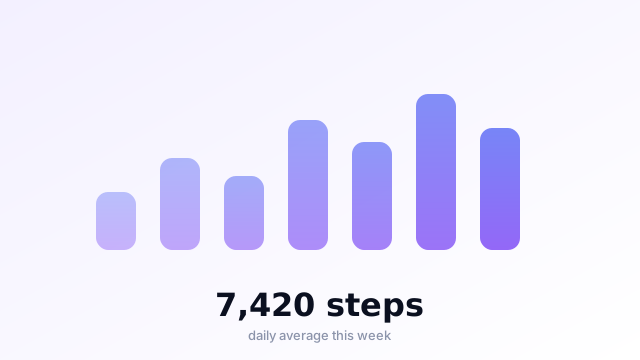
In the run-up to the 1964 Tokyo Olympics, a Japanese company began selling a pedometer called manpo-kei — the ten-thousand-step meter. The name was catchy, the device sold, and six decades later most of the planet believes ten thousand is a clinical threshold. It never was.
What has happened since is more interesting: researchers went and measured it.
What the research actually found
Large observational studies that track step counts against health outcomes keep producing the same shape of result. Risk drops steeply as people move from very low activity to moderate activity, and the curve then flattens.
- The steepest gains appear between roughly 2,000 and 7,000 steps a day. This is the range where getting off the sofa pays the most.
- Benefits generally level off between about 7,000 and 9,000 steps for middle-aged adults.
- In older adults, much of the benefit appears at lower counts — often around 6,000 to 8,000.
- Walking faster adds benefit beyond the raw count, though total volume matters more.
In other words, the person going from 3,000 to 6,000 steps gains far more than the person going from 9,000 to 12,000. If you are chasing the last two thousand steps at 11 p.m., you are optimising the flattest part of the curve at the cost of your sleep.
Read your own baseline first
Track a normal week without changing anything. If your average is 4,200, then 6,000 is a real target and 10,000 is a fantasy that will be abandoned by week three.
Building a target that survives
Take your current weekly average and add roughly 1,500 steps. Hold that for two weeks. Add again. This sounds slow, which is precisely why it works — every step target that gets abandoned was set from ambition rather than from a baseline.
Where the steps come from
Nobody finds three thousand extra steps in one heroic walk. They come from structural changes to an ordinary day:
- Get off one stop early. Reliably 1,000–2,000 steps, twice a day.
- Walk during phone calls. A 20-minute call is roughly 2,000 steps.
- Split lunch. Eat, then walk ten minutes. Also helps afternoon alertness.
- Take the long way to anything. The far coffee machine, the other exit, the upper floor.
- One evening loop. Fifteen minutes after dinner does more for sleep than it does for step count, which is a bonus.

Kiva's take
A 6,000-step day you actually repeat beats a 12,000-step day you manage twice a month. Consistency is the whole game.
What steps do not cover
Walking is excellent for general activity, cardiovascular health, mood and sleep. It does not load your muscles or bones enough to maintain strength as you age. Two short resistance sessions a week — bodyweight is fine to start — cover what stepping cannot.
Also worth knowing: phone step counts are reasonable but not exact. They miss steps when your phone is on a desk and add phantom steps in a car. Use the weekly trend, not the daily digit.
Frequently asked questions
Where did the 10,000 steps target come from?
From a pedometer sold in Japan in the 1960s called manpo-kei, literally the ten-thousand-step meter. It was a product name that became a global health target, not a conclusion from research.
How many steps a day are enough?
Studies consistently find health benefits rising steeply from very low step counts and levelling off somewhere between roughly 7,000 and 9,000 steps a day for most adults, with older adults seeing much of the benefit even lower.
Do steps replace proper exercise?
Not entirely. Walking covers general activity and cardiovascular health well, but it does not provide the muscle and bone stimulus of resistance training. The two do different jobs.
Keep reading
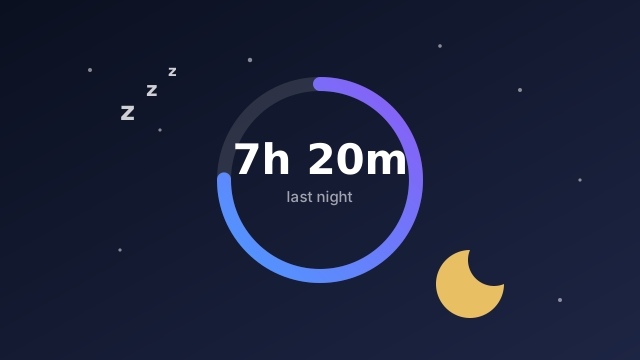
How much sleep do you actually need?
The honest answer to the 8-hour question, why sleep debt compounds, and what to fix first.
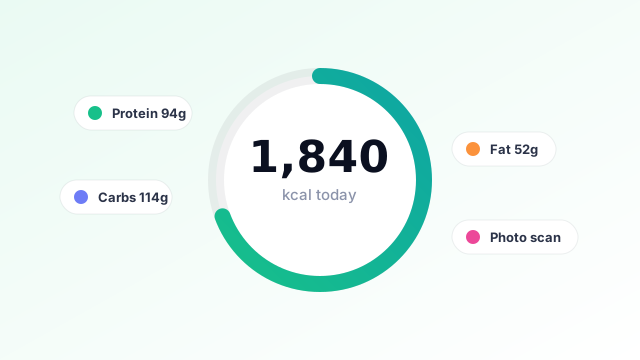
How much protein do you actually need?
Grams per kilo, not percentages — and why how you spread protein across the day matters more than the exact daily total.
Read how we select sources, prepare bilingual content, verify calculations and handle corrections in our editorial policy. Professional medical review is present only when explicitly stated.